This post I will delve into my discoveries of the inclusion
of Information Communication Technologies (ICT) in the classroom, and why it
has a very important place in today’s education system. From this discussion
you will not only discover how ICT can further prepare students to be more
active and successful in today’s society, but also how it can be a great tool
for the educator to give and get real time data.
 |
| Picture 1 |
The NMC Horizon report
suggest that growing pressure is being put on teachers to understand how to use
ICT tools and also to integrate them that foster more authentic digital
learning (Horizon, 2014) .
Advancements of
computers and the internet in the twenty-first century are changing the way
education can be delivered. Education has moved from the teacher standing at
the front of the classroom and delivering the learning material (teacher
centred learning) to the current movement of student centred learning where the
students interested is sparked by relevant community related questions. The
students will then conduct their own research and the teacher role becomes more
of a mentoring role, guiding the students while allowing them to have a more of
a say in their own learning (Horizon, 2014) . With student
centred learning it may be expected that schools should be providing ways for
students to continue to engage in learning activities, formal and informal,
beyond the traditional school day (Horizon, 2014) . From the previous
examples and the fact that work is underway to develop deeper learning
approaches (where ICT excels) it can easily be seen that teachers will need to
be competent in ICT to allow students to follow the student centred learning path.
I have included the Digital technologies I enjoyed exploring
in class into four categories of digital technology:
 |
| Picture 2 |
2. Digital
platforms – Weebly, Wikispaces
3. Presentation
tools – Bubbl.us, PowerPoint
4. Learning
support tools - Voki
Now that technologies are making their way into classrooms
it is important for teachers and students to be aware of the legal and ethical
ramifications of not adhering to the school and government policies. This can
easily be done by bringing policies to everyone’s attention and by the teacher
also making sure that they demonstrate these procedures while they are
conducting all tasks.
 |
| Picture 3 |
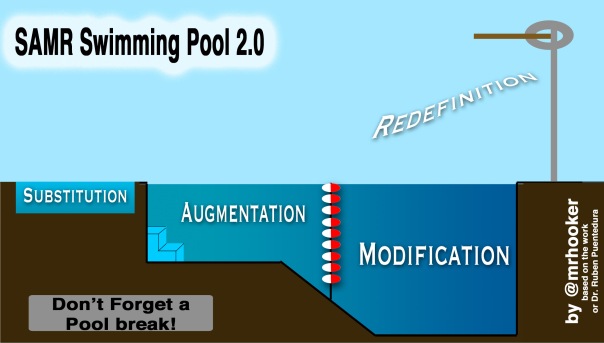
Throughout the last seven weeks I have hopefully discovered
the meanings and the links between Digital Pedagogy, Bloom’s Taxonomy and the
SAMR model. The SAMR model is a tool that can provide teachers with a way to
select self-reflect and refine how they incorporate ICT into their practice and
pedagogy. These three tools are critical if the teacher is trying to develop
successful digital pedagogy. ICT has the biggest impact on learning outcomes in
the more complex areas of Blooms Taxonomy of analysis, synthesis and
evaluation. Therefore when developing a lesson the teacher needs to understand
what level of learning outcomes their students are at in regards to Blooms Taxonomy,
and aim for those levels while incorporating ICT’s based on the SAMR model
preferably at the transformative level (modification or redefinition). This
will insure the best possible learning outcomes for the students.
Digital pedagogy, Blooms Taxonomy and the SAMR model was hard
for me to comprehend in the context of my teaching discipline of Industrial
Technology and Design. I could not really visualise how I could incorporate ICT
into my teaching area but I do believe I can incorporate it into my theory
lessons in the future with more personal development and experience.
Overall, I really enjoyed being exposed to new websites and
learning the new skills that go along with operating them. This experience will
be of great benefit to me as an educator and more importantly will help improve
lesson engagement with my students in their learning material. I believe the
best teachers have the option to incorporate all the tools available to them to
achieve greater student academic results, therefore, if a teacher wants to
continually improve as an educator they need to stay abreast of the latest
technologies available to them.
Works Cited
AITSL. (2013).
Retrieved from
http://www.aitsl.edu.au/australian-professional-standards-for-teachers/standards/list
AITSL. (2014).
Retrieved from http://www.aitsl.edu.au/australian-professional-standards-for-teachers/search?&fc=CareerStage!graduate&fc=Scope!Iop&t=2&fc=Focus!3.1
Horizon, N.
(2014). NMC Horizon Report. Retrieved from
http://cdn.nmc.org/media/2014-nmc-horizon-report-k12-EN.pdf


